Saturday, 29 November 2008

Experiment: Portrait - Stuart Leckenby

I played around at college today in the classroom taking some portraits of Stuart while engaging in conversation with him.
I asked him different questions such as what his most fond memories where, and what his best Christmas present was as a kid. The reasons I asked him these, was to relax him, and get the real Stuart, and also to get some real emotion from him, real emotion shines through in the eyes, and this is what I wanted to capture: the real Stuart Leckenby.

Here are my favourite shots:


I'm really proud of this picture, I think the focus is good, and the light in the eyes, I like I have really captured something in this image.


This is the other picture from the set that I really like, I feel like I have captured a genuine smile in this photograph, something which is sometimes hard!

Experiment: One foggy night...

Tonight was a night I have been waiting for! It was foggy and I really wanted to experiment with some photography in the fog and how light can look.

I took quite a few photographs, below are my favourite three. I took them on an ISO of 1600 so there is quite a bit of noise. I'm going to look at how I can reduce that using Photoshop, but they don't look too bad quality wise other than that.

I took them in mono as I felt that black and white gave the photographs good balance.


I like how in the image above, the light almost looks like it is being emitted from the tree itself, the fog has some interesting effects on the light, emphasising the beams as they shine through the branches of the tree. I would love it if I had a filter for my lens, as the beams would have looked even more powerful!


I love the lighting in the picture above, how it reflects off the leaves and the tree trunk, and this with the contrasting dark branches makes this image dynamic; almost as if the light is dripping from the tree. The fog seems to hold the light in place, almost slowing its escape from its source.


Again in this picture I like the contrast between light and dark. Had this been a clear night the light would be strong around the street lamp, and dark in the sky surrounding it; but the fog reflects the light over and over; brightening the sky.

Look closely at the below image, and there is a faint eerie figure under the light,


I cant decide whether I prefer the suttle character in the image above, or the more obvious, yet still unnerving silhouette below:


The final image from this shoot I would like to try again, using a tripod. I slowed the shutter speed down (10sec) to capture orb-like car lights moving through the foggy night.


However for this image to have been successful I feel the image needs to be in crisp focus with the light softly moving through. So I will practice this another time using a tripod.

Thursday, 27 November 2008

Experiment: Self Portrait - Red Petals

Today I experimented doing some self portrait work, working with natural daylight. I found self portraits hard! Especially as I took the images of myself whilst laying down.

After taking a bunch of photographs, I selected the ones I was most pleased with, and altered some of the levels slightly on Photoshop, just to enhance some of the colours.


I like the composition on this picture; the angle, with the direction of my eyes means the photograph flows well.


I know this photograph is slightly out of focus, but I like the colours on this image. The vibrant reds work nicely with the complementary blues of the eyes.


And finally, my favourite out of the set. I think the colours in this image are striking, however I would like the blues in the eyes to be more enhanced. I also like the lighting on my skin; it's flattering, no ageing shadows, just soft ones.

Composition is very hard to work out in a self portrait, I just had to use my judgement, and much of the time it worked. Because I controlled the colour and the set, and played around with positions to achieve correct lighting, it came together well in the end.

Wednesday, 26 November 2008

Ideas: Negative Weathering

I would like nature to have a direct impact on my work. I don't want to just photograph forces of nature, but let nature influence my work, nature can be unpredictable, and I would like my work to reflect that.

An idea I have had is to take some photographs, landscape ones, using a 35mm camera. Once I have processed the negatives I would like to weather them, leave them in the wind, rain and the cold. Expose some to elements, for example, fire; gently burn negative, water; flick water onto them before exposing the image, and gently damage them with earth; run earth onto them, so they become dirty, and slightly scratched.

Once the weathering has taken place on the negatives, expose images from them and see what the results are. I may expose images before weathering process to compare the degree of impact the weathering has caused.

Ideas: People facing the elements

After looking at Bad Weather, by Martin Parr, I felt inspired.

I think I may attempt something similar in my experiments. I will buy a cheap disposable camera and photograph people facing the elements, walking to work in the pouring rain, waiting for the bus in howling wind or carrying shopping bags home in the snow.

Talk from Martin Parr

Today I attended a talk from Martin Parr at College. I was looking forward to this very much and he didn't disappoint. He was as humorous as much of his work, and was extremely interesting to listen to.

He talked about his main collections of work up to date, and things he currently working on.

His work 'Bad Weather' particularly interested me in relation to my current project.


From 'Bad Weather' (1982)

Bad weather is a twist on the sunny, summer days being the 'perfect day for photography'. Parr wanted to take photographs on the days when weather was particularly dismal, trying to make interesting photographs of normally dull places on dull days.


From 'Bad Weather' (1982)

British society is obsessed with talking, or complaining about the weather. Parr bought a waterproof camera and braved the elements without the worry of damaging his equipment. The picture above is a fabulous image, the mist and the rain is so dramatic, and the specks of rain of moisture on the lens really gives the viewer a sense of what it would be like for the gentlemen in the photograph.

Ideas: Element themed fashion/beauty photography

As part of the work towards my final piece, I would like to do some simple fashion/beauty shoots with the natural elements being the main theme.

Earth
Wind
Fire
Water

Due to being limited what I can use in my shoots, and my budget, the elements will be represented, rather than present.

I will qualify the elements using colour, movement, the pose of the model, lighting and choice of clothing.

For earth, the set will be adorned with neutral colours; browns, auburns, oranges. Think autumnal colours, leaves, neutral make up, brown velvety fabric; warmth.

Wind will be all about movement, flowing hair, flowing fabrics, poses illustrating some kind of resistance against an invisible force.

Fire will consist of very bold reds, contrasting with black. Strong, feisty poses. This shoot should look sexy, perhaps modelling underwear. Dark, sexy make up.

Even though water can be powerful, I'd like the water shoot to seem peaceful, serene. Contrast in fabric, dark heavy blue tones, with sheer light blue tones. Glitter and shimmer, flowing hair, ideally blonde. The model should be laid down and entwined with the fabrics, I'd like to achieve a sense of flowing. Pale make up with blues from the fabric on the eyes.

In the mean time, I will explore these films through make-up. Illustrating the elements with make up and then photograph the girls wearing it. I will then take the project on from there.

Tuesday, 25 November 2008

Research: Susan Hiller

Susan Hiller is an English born artist who creates installations, using a variety of media, citing minimalism, surrealism and anthropology. While looking through her work I came across an ongoing project named 'Homage to Yves Klein' (2005).


Homage to Yves Klein (2005)

I find these series of photographs very interesting, these images are inspired by the photo below by Yves Klein.


Yves Klein, Leap into the Void

I love Susan Hillers take on Klein's photograph, she has twisted it to give the characters superhuman qualities. Even though the work was started in 2005, the photography has a more classic feel to it, with it being monochrome and the content choices, such as old cars, and choice of clothing on the people. I like how Hiller has taken a piece of work that inspires her, and created her own unique series.

I'd like to explore superhuman qualities within my own work, I feel it would be an exciting way to depict forces of nature.

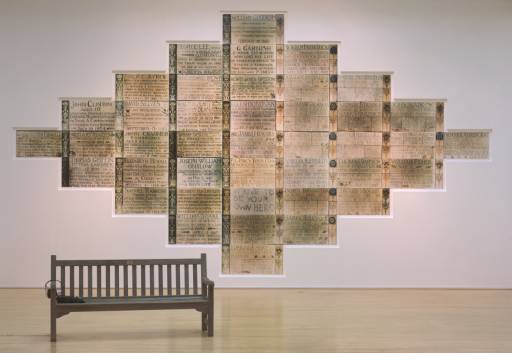
Other works by Hiller that references superheroes is her installation, Monument (1980-1981) which consists of 41 colour photographs of plaques honouring Londoners who have died saving someone else. The park bench is equipped with headphones, so visitors can sit down and listen to Hiller's narritve on death, heroism, immortality, gender, and representation, and themselves then complete the installation. It seems like facinating, memorable piece of work.


Monument (1980 - 1981)

Research: Cornelia Parker

Cornelia Parker is a British installation artist, who was short-listed for the Turner Prize in 1997.


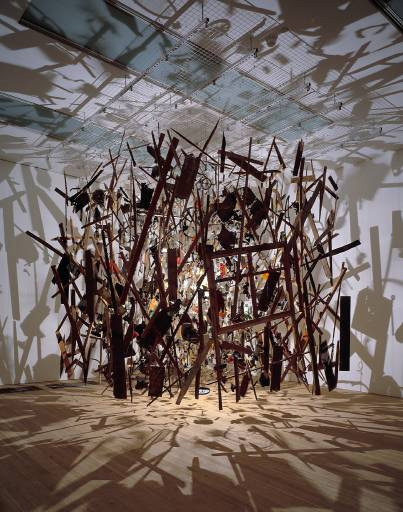
Cold Dark Matter: An Exploded View (1991)

Her work has the essence of being suspended in time, almost as if in mid explosion. I love the use of lighting in Cold Dark Matter, it makes the pieces seem very dramatic, the shadows cast around it are very dynamic.


Thirty Pieces of Silver (2003)

Parker is quoted as saying "I resurrect things that have been killed off... My work is all about the potential of materials - even when it looks like they've lost all possibilities"

I really think Parker is successful at bringing life to inanimate objects, I'd love to feel the sensation of seeing her work in real life, I can imagine it would feel quite strange; like time had stood still.


The sense of suspension in space and time in Edge of England (1999)

Tuesday, 11 November 2008

Research: Tim Knowles - Letting Nature do the work!


Tim Knowles
allows nature to generate his work. He aims to acheive a "unique and un-human quality and aesthetic" in his work. It is usually displayed as an installation as he believes communicating the processes is just as important as the work itsellf; displaying the drawings, apparatus, video and photography.


Not only has he created pictures by attaching pencils to trees like the one above, but he has experimented with photography, which particularly interests me. It's the actual photograph of the work above taking place the I like; the locations Knowles has selected for his work to be conducted are beautiful, as are the shadows of the tree branches on the canvas.

The work below is a collection of photographs taken on a slow shutter speed of the reflection of the moon on water. They are wonderful; they have such a peaceful quality to them, almost like smoke. They don't seem like photographs, as without knowing what the subject is, I'd never had guessed!


He has explored the effects of light in photography further in 'Nightwalks', Knowles records his path through woodland at night using a long exposure, creating a wonderfully composed photograph, with curious lighting.


Friday, 7 November 2008

Dictionary Definitions of Forces and Nature

Nature: (na ture) noun

  1. The material world, esp. as surrounding humankind and existing independently of human activities.
  2. The natural world as it exists without human beings or civilisation.
  3. The elements of the natural world, as mountains, trees, animals or rivers.
  4. The universe, with all its phenomena.
  5. The particular combination of qualities belonging to a person, animal, thing, or class by birth, origin, or constitution; native or inherent character: human nature.

Force: (fawrs, fohrs) noun
  1. Physical power or strength possessed by living being.
  2. Strength or power exerted upon an object.
  3. Power to influence, affect, or control; efficacious power.
  4. Unlawful violence threatened or committed against persons or property.
  5. Persuasive power; power to convince
  6. Physics: an influence on a body or system, producing or tending to produce a change in movement or in shape or other effects.
  7. Often, forces. the military or fighting strength, esp. of a nation


I like the definition of 'physical power possessed by a living being' and reference to 'human nature'. It is important that I include human themes in my work, as my interest lies in portrait and fashion photography.

Thursday, 6 November 2008

Brief: Forces of Nature

Context

During this brief consider 'forces of nature'.

The forces of nature have had an impact on organic and human existance since the creation of life. Even the broadest academic and spiritual views of our age cannot come close to understanding the true impact and cycles of natural forces and the potential they can hold.

Brief


With consideration to the varied disciplines within art and design you are to consider the title:-

Forces of Nature

Identify your own focus or particular area of interest. You may use scientific methods, or explore a scientific theme. You may consider an expressive investigation focused to fine art painting or sculpture. You may identify a range of problems to solve as a design in product or fashion. You may already have ideas from your last project that can be developed. It is now time for you to fully engage with your favoured disciplines within media, art and design

Produce a substantial body of research and experimentation or development work, showing consideration of a range of ideas and possibilities. Include media experiments and test pieces. Select you preferred concept and appropriate media/processes to resolve and realise your intentions/ideas.

Research the work of other artists/designers who have used methods or explored themes related to nature. Record your analysis (visual and critical) and your responses to their work in your journal, maintain an ongoing journal on your personal investigations.

Include evidence of an applied creative methodology. You can make experiments, mix things up, collect and classify objects and/or drawings, think about how you record your development - is it scientific or intuitive? Think about the processes, images, materials, and objects used in your observation and enquiry. Use a variety of research methods, including primary experiences/observations.

Your final pieces may take the form of drawings, photos, paintings, 3D objects, computer images, prints, video, textiles, books, machines.

Consider and identify the fine art/design context within which you are working.

Note: During key stages of this brief you will be expected to deviate, adapt and consider alternative creative stimuli, and include your considered responses as integral elements or chapters within your overall investigation (confused? - good!)

Welcome

Welcome to my online journal.

Here I will document my progress through briefs, showing my work, research, experiments and notes.